Here is all you need to know about HIV/AIDS.


What is HIV?

Human Immunodeficiency Virus, also known as HIV, is a virus that attacks the immune system, particularly white blood cells called T-helper cells, specifically a subset of T-cells called CD4 cells. These cells normally protect you from infection-causing microorganisms, such as viruses, fungi and bacteria. When one is infected with HIV, these cells are killed off and the virus rapidly creates new copies of itself, leaving you unable to fight off germs and vulnerable to a variety of illnesses and opportunistic infections, thus making it harder or impossible for the body to fight infections and cancers.


Who is affected by HIV?

First identified in around 1986, HIV has two subtypes, HIV-1 and HIV-2. Infection with either has no racial, age, or geographical predilection and there are reported cases in nearly every country. About 38 million people are living with HIV around the world today with 1.8 million being newly infected in 2018, and over two-thirds of them live in Africa.

In 2018, 770 000 people died from HIV-related causes globally according to the World Health Organisation with 1.7 million new infections. HIV is commonest in the following groups:

  • Sex workers and their clients;
  • Men who have sex with men;
  • People who inject drugs;
  • People in prisons;
  • Transgender people


What is AIDS?

AIDS (acquired immune deficiency syndrome) is the final stage of HIV infection. It can take years for someone who is infected with HIV to reach this stage, even without treatment. When someone has a very low number of CD4 cells (less than 200 per cubic millimetre), has had one or more specific infections or certain cancers, that person is considered to have AIDS. Healthy adults have between 500 to 15000 CD4 cells per cubic millimetre.


How is HIV transmitted?

The virus is present in semen, blood, breast milk and vaginal as well as anal fluids. It is commonly transmitted through:

  • unprotected vaginal or anal sexwith an infected partner. This is responsible for a large majority of cases. It can also be transmitted via oral sex.
  • blood and blood products transfusions,
  • sharing needles and other equipment among drug users,
  • organ transplantation,
  • infected needle-stick injuries to healthcare workers,
  • or from mother to child during pregnancy, delivery or breast-feeding.

HIV cannot be spread by ordinary day-to-day contacts such as kissing, hugging, shaking hands, or sharing personal objects, food or water.


What are the Symptoms of HIV?

Within 3 to 6 weeks of infection with HIV, more than 50 per cent of individuals experience some symptoms. Here, the body reacts to the killing of CD4 cells and the spread of HIV copies leading to the symptoms seen which may include the following:

  • Rashes or sores on the skin
  • Fevers
  • Lethargy
  • Malaise
  • Muscle pain and weakness
  • Night sweats
  • Diarrhoea
  • Yeast infections
  • Nausea and/or vomiting
  • Fatigue
  • Shortness of breath
  • Short-term memory loss
  • Weight loss
  • Swollen lymph nodes
For some, this initial phase does not lead to any symptoms. Generally, people living with HIV are most infectious in this early stage and can easily transmit the virus to others. After this initial phase, the symptoms tend to disappear, signalling that the virus has now been established in the body and able to replicate and spread uninhibited. This is the second stage of infection.

HIV silently develops over 5 to 10 years, killing off and impairing CD4 cells, leading to the development of a state of little or no immunity (called AIDS -acquired immune deficiency syndrome). At this stage, a barrage of diseases caused by viruses and opportunistic infections (AIDS-defining illnesses) may result, causing varying symptoms and complications in different systems affected, as well as cancer


How Can I Protect Myself from Contracting HIV?

The following tips are necessary for protecting yourself from HIV

  1. Abstain from sex. If you are sexually active, use condoms for penetrative sexual acts and dental dams for oral sex.
  2. Get tested for HIV and other sexually transmitted infections.
  3. Be faithful to your HIV-negative partner who is equally faithful.
  4. Treat sexual infections as soon as you notice symptoms
  5. Do not share sharp objects, like razor blades or injections.
How is HIV treated?

Specific medications designed to slow or halt the spread of HIV within the cells in the body via different mechanisms have been designed. These drugs work in different ways and are often combined (three or more medications) to keep the viral load (amount of HIV cells in the body) to a minimum. These medications (called Anti-Retroviral or ART) also among of it are very Effective and strong immune booster  called pure and broken ganodema medication which as also helps  millions  people living with HIV live normal lives.


Introducing Well Researched Plants And Fruits Extract For Optimum Medication"The Most Powerful Natural Supplement For HIV!


NOTE: " HIV NATURAL SOLUTION PACK PACK " is a marketing name only. Every single components mentioned above are packed inside the DELIVERY box and hence, if you do not see HIV NATURAL SOLUTION PACK PACK written on the pack, please don’t be afraid.

And the best part is that, just making use of this HIV NATURAL SOLUTION PACK PACK has helped a lot of people to reduce the count of the deadly virus

HOW THE HIV NATURAL SOLUTION PACK WORK 


PURE&BROKEN GANODERMA


  BENEFITS

  1.100% shell broken hence easier to absorb and 45% easier to absorb
  2. Improve physical health
  3. Boost the immune system
  4 Reduce side effects from chemotherapy e.g. hair loss
  5. Raise appetite
  6. Improve blood circulation to the colony artery
  7. Prevent atherosclerosis and heart problems
  8. Balance blood sugar level
  9. Cure neural system problems
  10. Endocrine system
  11. Respiratory system
  12. Locomotory (White blood cell multiplication) 13 Anti - tumor
  14. Improve skin conditions
  15. Good for allergy due to lanostan which blocks histamme
  16. Anti- inflammatory
  17. Protects the liver and normalize the liver
  18. Strong ant-viral, anti- parasite,
  19. Strong anti-viral, anti-parasite, anti-fungal and anti- bacterial
  20. Lowers blood pressure
  21. Lowers blood sugar
  22. Strong anti-oxidant
  23. Fights insomnia
  24. Good for fatigue
  25 Enhance metabolism
  26. Raises CD4 counts in the blood thus very good for HIV/AIDS
  27. Anti-diabetics
  28. Clears blood clots
  29. Detoxifies the blood
  30. It is analgesic relieves pain
  31. Reactivates body energy and prolong healthy life
  32. Good for chJonic ulcers
  33. Vomiting
  34. Good for any Anti-immune Disease e.g. Psoriasis
  35. Good for Anemia
  36. Suitable for any chronic condition


REISHI COFFEE


4 IN 1 Reishi Coffee with mushroom&Ganodema Extract


   BENEFITS


  1. Boosts Immunity System

  2. Promotes self healing.

  3. Refreshes the brain and energizes the body.

  4. Reduces arousal and thus improve mental alertness.

  5. Prolongs sleeping time.

  6. Prevents allergy due to lanostan which blocks histamine.

  7. Prevents virus infection. Good for HIV and influenza.

  8. Prevents formation of blood clots.

  9. Reduces uric acid.

  10. Prevents viral infection of the liver (Hepatitis).

  11. Good for kidney problems.

  12. Strengthens the digestive system.

  13. Strengthens the heart muscles.

  14. Good for skin conditions such as Psoriasis, acne, etc

  15. Stimulates the bone marrow to produce new blood cells.

  16. Improves sinusitis.

  17. Good for hormonal imbalance.

  18. Good for respiratory problems .e.g. pneumonia. 


Manufactured in Los Angeles U.S. Cerified By FDA And Other International Organisations!
 

 Therefore, Get Our Natural Prostate Care Pack Today For Your Optimum Prostate Health. These Products Combination Below Can Be Delivered To You.


Here Below The Cost Analysis Table For You To Place Your Order At A Huge Discounted Price

COST PRICE 
one month pack #44,500
Use The Form Below To Place Your
Order Our agent will communicate
 with you to update you on the Delivery
 process in a day to your Delivery or
 on the Delivery date

Knowledge is power! Well done for reading up to this point. The most important step however begins now because information is only of value if you act on it. I look forward to hear Our HIV Care Pack success story from you. Start fortifying your prostate gland and it will reward you with sound health.

Sincerely Yours
CONSULTANT REUBEN
Men's Health Researcher


It is better to ask question than to remain ignorant. Therefore, do you have any question to ask or an enquiry to make? If yes, get in touch with me through any of the routes below!
 

For your enquiry


100% Safe, All Natural Solution To Overcome Stroke
Life is 10% what happens to you and 90% how you react to it...Charlse R. Swindoll

Welcome to livinghealthinex Support Site. We provide you with first hand information on various natural ways to normalize your blood sugar and overcome stroke.
Since you are visiting, 

it means to us that you are probably somewhat frustrated with your inability to walk, talk and live like other healthy Nigerians.

That's easy for us to understand because we firmly believe that before now you may have tried other conventional ways to reverse your Stroke with little or no result.

livinghealthinex offers you a FRESH APPROACH to treating and reversing your STROKE.. You are not alone: many people are in the same condition. 

Moreover, there is a solution, so you should not despair or give up. As you are about to learn, STROKE can be overcome and reversed.

Overview

A stroke occurs when the blood supply to part of your brain is interrupted or reduced, depriving brain tissue of oxygen and nutrients. Within minutes, brain cells begin to die.

A stroke is a medical emergency. Prompt treatment is crucial. Early action can minimize brain damage and potential complications.

The good news is that strokes can be treated and prevented, and many fewer Americans die of stroke now than in the past.

Symptoms

Watch for these signs and symptoms if you think you or someone else may be having a stroke. Pay attention to when the signs and symptoms begin. The length of time they have been present can affect your treatment options:

Trouble with speaking and understanding. You may experience confusion. You may slur your words or have difficulty understanding speech.
Paralysis or numbness of the face, arm or leg. You may develop sudden numbness, weakness or paralysis in your face, arm or leg. This often happens just on one side of your body. Try to raise both your arms over your head at the same time. If one arm begins to fall, you may be having a stroke. Also, one side of your mouth may droop when you try to smile.
Trouble with seeing in one or both eyes. You may suddenly have blurred or blackened vision in one or both eyes, or you may see double.
Headache. A sudden, severe headache, which may be accompanied by vomiting, dizziness or altered consciousness, may indicate you're having a stroke.
Trouble with walking. You may stumble or experience sudden dizziness, loss of balance or loss of coordination.

When to see a doctor

Seek immediate medical attention if you notice any signs or symptoms of a stroke, even if they seem to fluctuate or disappear. Think "FAST" and do the following:

Face. Ask the person to smile. Does one side of the face droop?
Arms. Ask the person to raise both arms. Does one arm drift downward? Or is one arm unable to rise up?
Speech. Ask the person to repeat a simple phrase. Is his or her speech slurred or strange?
Time. If you observe any of these signs, the we have GOOD NEWS for you


Call 911 or your local emergency number right away. Don't wait to see if symptoms stop. Every minute counts. The longer a stroke goes untreated, the greater the potential for brain damage and disability.

If you're with someone you suspect is having a stroke, watch the person carefully while waiting for emergency assistance.

Causes

A stroke may be caused by a blocked artery (ischemic stroke) or the leaking or bursting of a blood vessel (hemorrhagic stroke). Some people may experience only a temporary disruption of blood flow to the brain (transient ischemic attack, or TIA) that doesn't cause permanent damage.

Ischemic stroke

Ischemic stroke

Ischemic stroke

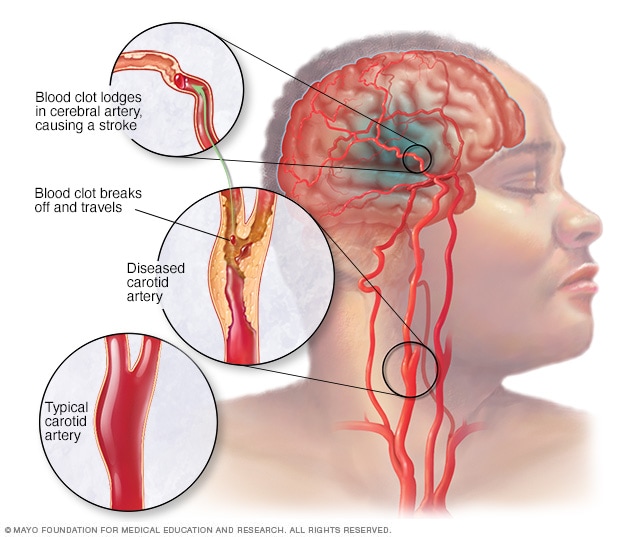
About 80 percent of strokes are ischemic strokes. Ischemic strokes occur when the arteries to your brain become narrowed or blocked, causing severely reduced blood flow (ischemia). The most common ischemic strokes include:

Thrombotic stroke. A thrombotic stroke occurs when a blood clot (thrombus) forms in one of the arteries that supply blood to your brain. A clot may be caused by fatty deposits (plaque) that build up in arteries and cause reduced blood flow (atherosclerosis) or other artery conditions.
Embolic stroke. An embolic stroke occurs when a blood clot or other debris forms away from your brain — commonly in your heart — and is swept through your bloodstream to lodge in narrower brain arteries. This type of blood clot is called an embolus.

Hemorrhagic stroke

Hemorrhagic stroke occurs when a blood vessel in your brain leaks or ruptures. Brain hemorrhages can result from many conditions that affect your blood vessels. These include:

Uncontrolled high blood pressure (hypertension)
Overtreatment with anticoagulants (blood thinners)
Weak spots in your blood vessel walls (aneurysms)

A less common cause of hemorrhage is the rupture of an abnormal tangle of thin-walled blood vessels (arteriovenous malformation). Types of hemorrhagic stroke include:

Intracerebral hemorrhage. In an intracerebral hemorrhage, a blood vessel in the brain bursts and spills into the surrounding brain tissue, damaging brain cells. Brain cells beyond the leak are deprived of blood and are also damaged.

High blood pressure, trauma, vascular malformations, use of blood-thinning medications and other conditions may cause an intracerebral hemorrhage.

Subarachnoid hemorrhage. In a subarachnoid hemorrhage, an artery on or near the surface of your brain bursts and spills into the space between the surface of your brain and your skull. This bleeding is often signaled by a sudden, severe headache.

A subarachnoid hemorrhage is commonly caused by the bursting of a small sack-shaped or berry-shaped aneurysm. After the hemorrhage, the blood vessels in your brain may widen and narrow erratically (vasospasm), causing brain cell damage by further limiting blood flow.

Transient ischemic attack (TIA)

A transient ischemic attack (TIA) — sometimes known as a ministroke — is a temporary period of symptoms similar to those you'd have in a stroke. A temporary decrease in blood supply to part of your brain causes TIAs, which may last as little as five minutes.

Like an ischemic stroke, a TIA occurs when a clot or debris blocks blood flow to part of your nervous system — but there is no permanent tissue damage and no lasting symptoms.

Seek emergency care even if your symptoms seem to clear up. Having a TIA puts you at greater risk of having a full-blown stroke, causing permanent damage later. If you've had a TIA, it means there's likely a partially blocked or narrowed artery leading to your brain or a clot source in the heart.

It's not possible to tell if you're having a stroke or a TIA based only on your symptoms. Even when symptoms last for under an hour, there is still a risk of permanent tissue damage.

Risk factors

Many factors can increase your stroke risk. Some factors can also increase your chances of having a heart attack. Potentially treatable stroke risk factors include:

Lifestyle risk factors

Being overweight or obese
Physical inactivity
Heavy or binge drinking
Use of illicit drugs such as cocaine and methamphetamines

Medical risk factors

Blood pressure readings higher than 120/80 millimeters of mercury (mm Hg)
Cigarette smoking or exposure to secondhand smoke
High cholesterol
Diabetes
Obstructive sleep apnea
Cardiovascular disease, including heart failure, heart defects, heart infection or abnormal heart rhythm
Personal or family history of stroke, heart attack or transient ischemic attack.

Other factors associated with a higher risk of stroke include:

Age —People age 55 or older have a higher risk of stroke than do younger people.
Race — African-Americans have a higher risk of stroke than do people of other races.
Sex — Men have a higher risk of stroke than women. Women are usually older when they have strokes, and they're more likely to die of strokes than are men.
Hormones — use of birth control pills or hormone therapies that include estrogen, as well as increased estrogen levels from pregnancy and childbirth.

Complications

A stroke can sometimes cause temporary or permanent disabilities, depending on how long the brain lacks blood flow and which part was affected. Complications may include:

Paralysis or loss of muscle movement. You may become paralyzed on one side of your body, or lose control of certain muscles, such as those on one side of your face or one arm. Physical therapy may help you return to activities affected by paralysis, such as walking, eating and dressing.
Difficulty talking or swallowing. A stroke might affect control of the muscles in your mouth and throat, making it difficult for you to talk clearly (dysarthria), swallow (dysphagia) or eat. You also may have difficulty with language (aphasia), including speaking or understanding speech, reading, or writing. Therapy with a speech-language pathologist might help.
Memory loss or thinking difficulties. Many people who have had strokes experience some memory loss. Others may have difficulty thinking, making judgments, reasoning and understanding concepts.
Emotional problems. People who have had strokes may have more difficulty controlling their emotions, or they may develop depression.

Pain. Pain, numbness or other strange sensations may occur in the parts of the body affected by stroke. For example, if a stroke causes you to lose feeling in your left arm, you may develop an uncomfortable tingling sensation in that arm.

People also may be sensitive to temperature changes, especially extreme cold, after a stroke. This complication is known as central stroke pain or central pain syndrome. This condition generally develops several weeks after a stroke, and it may improve over time. But because the pain is caused by a problem in your brain, rather than a physical injury, there are few treatments.

Changes in behavior and self-care ability. People who have had strokes may become more withdrawn and less social or more impulsive. They may need help with grooming and daily chores.

As with any brain injury, the success of treating these complications varies from person to person.

Prevention

Knowing your stroke risk factors, following your doctor's recommendations and adopting a healthy lifestyle are the best steps you can take to prevent a stroke. If you've had a stroke or a transient ischemic attack (TIA), these measures might help prevent another stroke. The follow-up care you receive in the hospital and afterward also may play a role as well.

Many stroke prevention strategies are the same as strategies to prevent heart disease. In general, healthy lifestyle recommendations include:

Controlling high blood pressure (hypertension). This is one of the most important things you can do to reduce your stroke risk. If you've had a stroke, lowering your blood pressure can help prevent a subsequent TIA or stroke.

Exercising, managing stress, maintaining a healthy weight and limiting the amount of sodium and alcohol you eat and drink can all help to keep high blood pressure in check. In addition to recommending lifestyle changes, your doctor may prescribe medications to treat high blood pressure.

Lowering the amount of cholesterol and saturated fat in your diet. Eating less cholesterol and fat, especially saturated fat and trans fats, may reduce the plaque in your arteries. If you can't control your cholesterol through dietary changes alone, your doctor may prescribe a cholesterol-lowering medication.
Quitting tobacco use. Smoking raises the risk of stroke for smokers and nonsmokers exposed to secondhand smoke. Quitting tobacco use reduces your risk of stroke.
Controlling diabetes. You can manage diabetes with diet, exercise, weight control and medication.
Maintaining a healthy weight. Being overweight contributes to other stroke risk factors, such as high blood pressure, cardiovascular disease and diabetes. Losing as little as 10 pounds may lower your blood pressure and improve your cholesterol levels.
Eating a diet rich in fruits and vegetables. A diet containing five or more daily servings of fruits or vegetables may reduce your risk of stroke. Following the Mediterranean diet, which emphasizes olive oil, fruit, nuts, vegetables and whole grains, may be helpful.
Exercising regularly. Aerobic or "cardio" exercise reduces your risk of stroke in many ways. Exercise can lower your blood pressure, increase your level of high-density lipoprotein cholesterol, and improve the overall health of your blood vessels and heart. It also helps you lose weight, control diabetes and reduce stress. Gradually work up to 30 minutes of activity — such as walking, jogging, swimming or bicycling — on most, if not all, days of the week.
Drinking alcohol in moderation, if at all. Alcohol can be both a risk factor and a protective measure for stroke. Heavy alcohol consumption increases your risk of high blood pressure, ischemic strokes and hemorrhagic strokes. However, drinking small to moderate amounts of alcohol, such as one drink a day, may help prevent ischemic stroke and decrease your blood's clotting tendency. Alcohol may also interact with other drugs you're taking. Talk to your doctor about what's appropriate for you.
Treating obstructive sleep apnea (OSA). Your doctor may recommend an overnight oxygen assessment to screen for OSA — a sleep disorder in which the oxygen level intermittently drops during the night. Treatment for OSA includes oxygen at night or wearing a small device in your mouth to help you breathe.
Avoiding illegal drugs. Certain street drugs, such as cocaine and methamphetamines, are established risk factors for a TIA or a stroke. Cocaine reduces blood flow and can narrow the arteries

ALL OUR PRODUCTS ARE 

Image result for MADE IN USA

We Recommend to You Our Stroke Preventive and Curative medications

Natural treatments for Stroke:
Recommended products to help improve your stroke condition: these are supplements for stroke


Therefore, Get Our Natural Prostate Care Pack Today For Your Optimum Prostate Health. These Products Combination Below Can Be Delivered To You.

Manufactured in Los Angeles U.S. Cerified By FDA And Other International Organisations!


NOTE: "STOKE NATURAL THERAPY PACK " is a marketing name only. Every single components mentioned above are packed inside the DELIVERY box and hence, if you do not see STROKE NATURAL THERAPY written on the pack, please don’t be afraid.

And the best part is that, just making use of this STROKE NATURAL PACK has helped a lot of people to overcome their STOKE NATURAL THER.


Here Below The Cost Analysis Table For You To Place Your Order At A Huge Discounted Price


COST PRICE 

Full pack#87,500 


Use The Form Below To Place Your
Order Our agent will communicate
 with you to update you on the Delivery
 process in a day to your Delivery or
 on the Delivery date

Knowledge is power! Well done for reading up to this point. The most important step however begins now because information is only of value if you act on it. I look forward to hear Our STROKE Care Pack success story from you. Start fortifying your prostate gland and it will reward you with sound health.

Sincerely Yours
CONSULTANT REUBEN
Men's Health Researcher


It is better to ask question than to remain ignorant. Therefore, do you have any question to ask or an enquiry to make? If yes, get in touch with me through any of the routes below!
 

For your enquiry